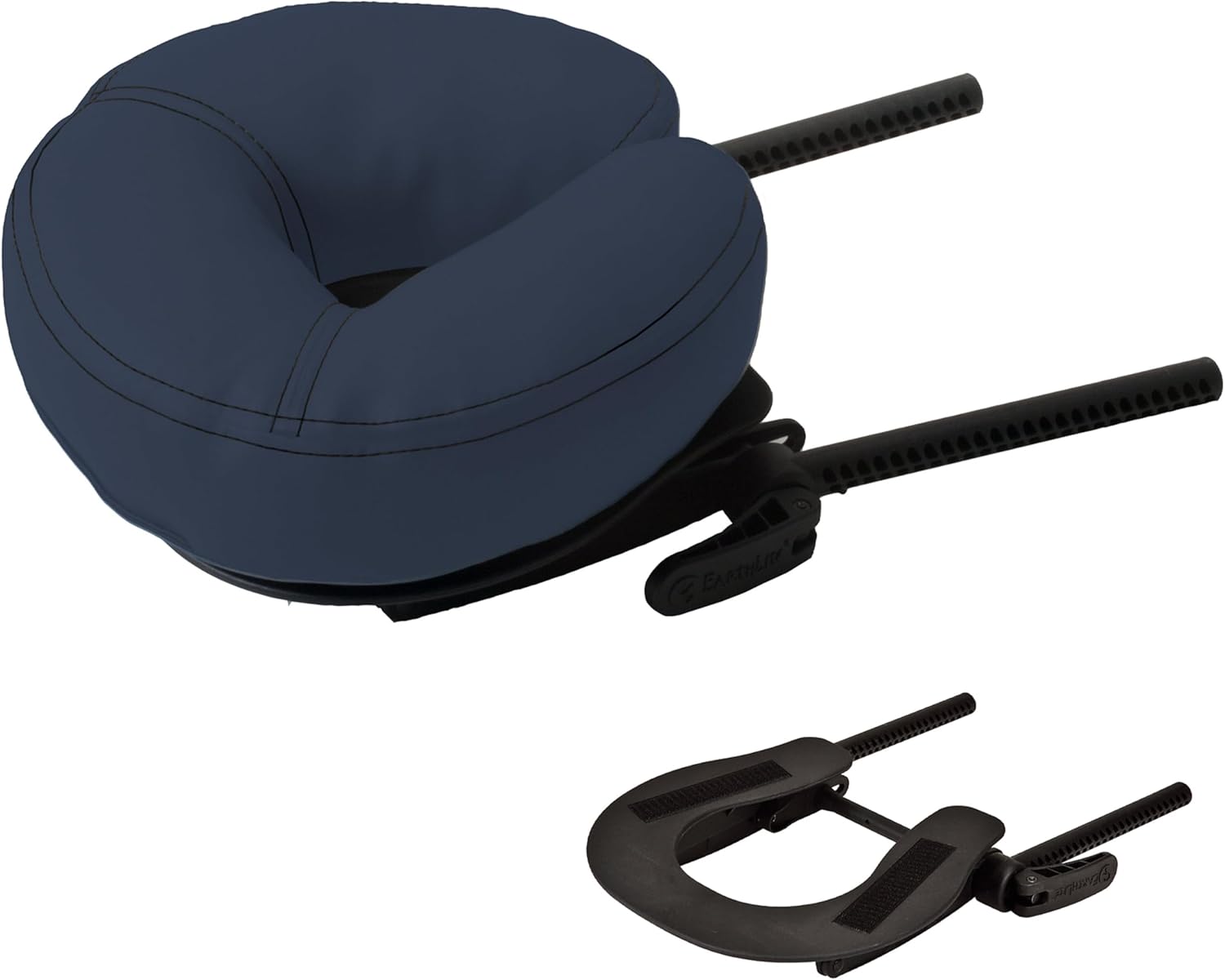
You just bought a new face cradle — the padded, U-shaped headrest that attaches to the end of a massage table and supports a client’s face while they lie prone (face-down). It arrives in two days, you have clients booked, and then you discover it won’t seat properly into the sleeve on your table. The mounting bracket is the wrong width. The extension arm is the right length but the wrong shape. Now you’re zip-tying a $90 accessory to a $600 table and hoping nobody notices.
This is the single most common return reason for massage table accessories, and it’s almost entirely avoidable. The core issue is that face cradle mounting systems are not standardized across the industry. Each major table brand — Earthlite, Oakworks, Custom Craftworks, TouchAmerica, Sierra Comfort, and others — uses its own sleeve-and-arm geometry, and the cradle frame that snaps cleanly into an Earthlite table will rattle, wobble, or simply not fit an Oakworks. This guide breaks down exactly how those systems differ, how to identify which system you have, and how to buy the right replacement or upgrade without guessing.
Why There’s No Universal Standard (And Why That’s Unlikely to Change)
The massage table industry never coalesced around a single mounting specification the way, say, bicycle components converged on standardized bottom bracket threading. Each major manufacturer developed its proprietary end-panel sleeve and arm geometry independently, and those design choices are now baked into decades of product lines and accessory ecosystems.
The functional anatomy of a face cradle system has three key parts:
- The sleeve (or receiver): The channel built into the table’s end panel that accepts the cradle arm. Sleeve width, depth, and internal geometry vary by brand.
- The extension arm: The rigid bar that slides into the sleeve and projects outward to position the cradle frame beyond the table’s edge. Arm width and cross-section profile (square vs. rectangular vs. oval) differ across manufacturers.
- The cradle frame: The padded U-shape that attaches to the outer end of the arm. Frame width, pivot hardware, and cushion attachment system all vary.
A mismatch at any of these three connection points creates either a loose, unsafe fit or a complete non-fit. AMTA’s equipment and ergonomic injury prevention resources note that an unstable face cradle is a direct liability risk — if a cradle shifts or detaches during a session, the client’s cervical spine (neck) is unsupported at the worst possible moment.
The Major Mounting Systems, Compared
Here’s where practitioners who’ve dealt with this problem consistently land, based on aggregated owner reports and published spec documentation from the manufacturers themselves.
Earthlite
Earthlite uses what the industry informally calls a “square-arm” system. The extension arm on Earthlite tables — including the Harmony DX, Sedona, and Spirit — is a square-profile aluminum bar that seats into a correspondingly square sleeve at the end panel. The arm width is spec’d at approximately 1 inch square.
Because Earthlite holds a large share of the portable table market, several third-party accessory brands have designed their arms to fit this square profile. That means you have meaningful upgrade options beyond Earthlite’s own branded cradles. However, “Earthlite-compatible” claims from accessory sellers should still be verified against the specific table model — Earthlite’s stationary and clinical tables do not necessarily share the same sleeve geometry as their portables.
Earthlite’s published product documentation is explicit that face cradle accessories from their Harmony DX line are not guaranteed to be compatible with their Ellora stationary series without an adapter.
Oakworks
Oakworks is the other high-volume manufacturer you’ll encounter most often, and their system diverges meaningfully from Earthlite. Oakworks uses a wider rectangular arm profile across most of their portable line (the Wellspring, One, and Massage in a Box series). Their Clinician and Pacific stationary series use a different receiver entirely — a heavier-gauge channel designed for clinical load requirements.
Oakworks’ own accessory compatibility guide, available through their product support documentation, explicitly states that face cradle arms are not interchangeable between their portable and stationary lines. Practitioners moving from an Oakworks portable to an Oakworks stationary table for a clinic setup often assume brand loyalty means accessory compatibility. It doesn’t — not automatically.
The upside: Oakworks’ branded face cradle systems are widely regarded by operators in long-run clinical reviews as among the most durable in the industry, with arm locking mechanisms that hold position under repeated adjustment cycles.
Custom Craftworks
Custom Craftworks tables — common in mid-range clinical and chiropractic setups — use a proprietary arm width that sits between the Earthlite and Oakworks dimensions. Their fitment documentation describes the arm as a “non-standard profile,” which is manufacturer-speak for: don’t assume any third-party cradle will fit without confirming measurements.
The practical implication: owners of Custom Craftworks tables report that their strongest compatibility is with Custom Craftworks’ own branded cradle system. Third-party aftermarket cradles tend to fit loosely, which most practitioners feel immediately as a slight wobble when the client turns their head. That’s not a minor annoyance — it’s a signal that the arm isn’t fully seated, which is a structural and liability concern.
Sierra Comfort
Sierra Comfort is the entry-level brand most common in student and first-year practitioner setups — the tables priced in the $150–$300 range that get you through school and early practice. Their face cradle systems tend to use thinner-gauge arms than professional-grade brands, and the sleeve receivers on Sierra Comfort tables are among the least standardized in the market.
ABMP’s practice setup resources for new practitioners consistently recommend that students confirm face cradle compatibility before purchasing any aftermarket upgrade for a Sierra Comfort table, because the sleeve tolerances on these tables vary even across production runs of the same model.
TouchAmerica
TouchAmerica primarily serves the commercial and institutional market — resort spas and multi-table wellness centers. Their stationary tables use heavy-duty proprietary face cradle arms that are engineered for high-volume clinical use. These are not interchangeable with portable table systems from any other brand. If you’re speccing accessories for a TouchAmerica fleet, source cradles directly through TouchAmerica or a verified distributor with fleet-pricing agreements.
By the numbers — arm width across major brands (published specs):
| Brand | Portable Arm Profile | Stationary Arm Profile |
|---|---|---|
| Earthlite | ~1″ square | Different — model-specific |
| Oakworks | Rectangular (wider) | Heavier-gauge channel |
| Custom Craftworks | Proprietary mid-width | Branded system only |
| Sierra Comfort | Thin-gauge variable | N/A (portable-only) |
| TouchAmerica | N/A | Heavy-duty proprietary |
Source: published product and accessory specification documentation from each manufacturer.
How to Identify Your Table’s System Before You Buy
If you already own a table and need to replace or upgrade the face cradle, here’s a practical verification sequence that sidesteps the guesswork:
Step 1: Measure your sleeve opening. Remove the existing face cradle arm and measure the internal dimensions of the sleeve at the end panel — width and height. Even a half-millimeter variance matters here because the fit is load-bearing.
Step 2: Cross-reference the manufacturer’s accessory documentation. Most major brands publish accessory compatibility guides on their websites or will provide them through customer support. Earthlite and Oakworks both maintain these as downloadable PDFs. Don’t rely on the retailer’s product listing description — go to the source.
Step 3: Confirm model-specific compatibility, not just brand compatibility. The question isn’t “does this cradle work with Earthlite?” It’s “does this cradle work with the Earthlite Harmony DX, 2023 production run?” Older tables within the same brand may use a previous-generation sleeve design.
Step 4: Ask the seller directly, in writing. If purchasing through a distributor, ask them to confirm compatibility with your specific table model before you order. Get that confirmation in an email or chat transcript. If the item doesn’t fit and you have documentation of a compatibility claim, returns are significantly easier to process.
The NCBTMB’s continuing education framework doesn’t cover equipment selection in detail, but practitioners expanding into prenatal massage — where an adjustable face cradle with extra range of tilt is essential — should note that specialty cradles (like Earthlite’s or Oakworks’ adjustable-tilt versions) are even less likely to be universally compatible than standard models, because their more complex pivot hardware requires a precise arm interface.
If X, Then Y — The Decision Rules
You’ve been patient. Here’s the clean decision framework:
If you own an Earthlite portable (Harmony DX, Sedona, Spirit): Start with Earthlite’s branded replacement cradles. If you want an aftermarket upgrade, look specifically for accessories labeled “Earthlite square-arm compatible” and verify the arm dimensions against your sleeve measurement before ordering.
If you own an Oakworks portable: Buy Oakworks. The proprietary arm geometry makes third-party options a consistent poor fit based on owner reports. The branded cradle system is more expensive but holds up to the adjustment cycles you’ll actually use.
If you own a Custom Craftworks table in a clinical or chiropractic setting: Source from Custom Craftworks directly, or call their accessory support line before ordering anything else. Third-party options have a poor fit track record on these tables.
If you’re running a Sierra Comfort as a student or first-year portable: Use the cradle that came with the table. If you need a replacement, contact Sierra Comfort’s customer service with your exact model number before buying anything — the sleeve variability on their tables makes even same-brand replacements a potential mismatch without model confirmation.
If you’re a spa director or clinic buyer speccing TouchAmerica or Oakworks Clinician stationary units: Source face cradle accessories through your fleet vendor or directly through the manufacturer’s commercial accounts team. The stationary systems for these brands are not compatible with portable-market accessories, and at $2,000–$6,000+ per table, this is not the place to save $30 on an aftermarket cradle.
If you’re expanding into prenatal massage and need an adjustable-tilt cradle: Confirm compatibility as if you’re buying a new table. Adjustable-tilt cradles are among the least cross-compatible accessories in the category. Earthlite and Oakworks both offer prenatal-capable cradle systems, but only within their own table ecosystems.
The bottom line is unglamorous but important: face cradle compatibility is a structural safety issue, not just a convenience issue. An unsecured cradle is an unstable support for a client’s cervical spine during prone bodywork. The five minutes you spend confirming compatibility before you order is an investment in both your client’s safety and your own liability protection — and it’s a lot cheaper than a return shipping label.