You’re eighteen months into your practice. You have a full client load, a Earthlite Harmony DX that lives in your car trunk, and a relative — let’s say your dad — who can’t get on a massage table safely after hip surgery. He’s at home. You want to help him. The portable table is doable, but the setup in his small bedroom feels precarious, and honestly, the floor is right there.
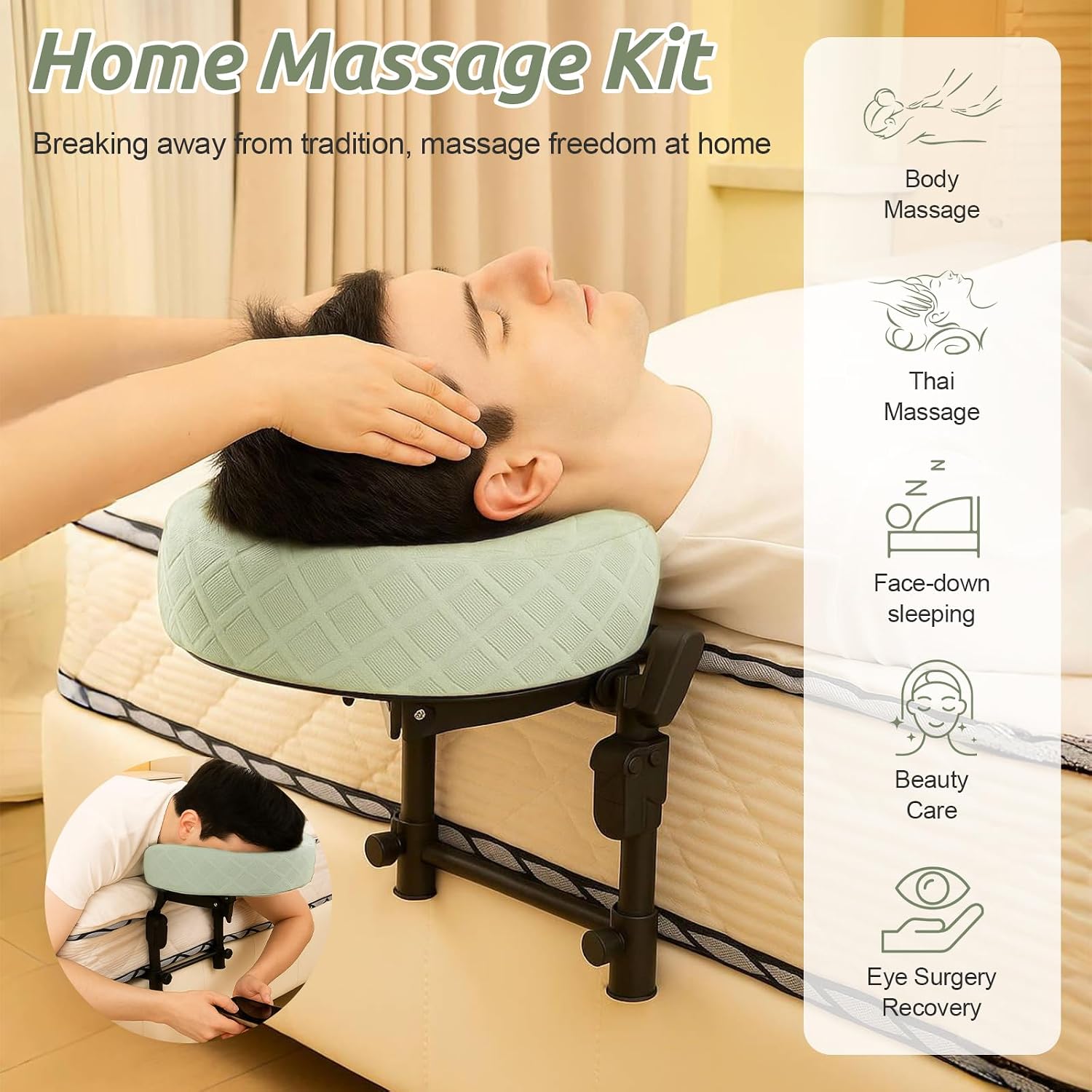
This is the exact scenario where a mattress-mount face cradle gets interesting. A face cradle is the padded U-shaped rest that supports a client’s face during prone (face-down) bodywork — it’s standard equipment on every massage table. A mattress-mount version is engineered to clamp or strap onto the edge of a standard bed mattress rather than a table frame, so the client lies prone on the bed itself while their face hangs supported over the cradle. The concept is legitimate. The execution has real variables. This article breaks down how these devices work mechanically, which clinical scenarios actually suit them, and the two or three situations where you’re better off with a different solution entirely.
How Mattress-Mount Face Cradles Actually Attach (and Why It Matters)
The fundamental challenge is load transfer. On a massage table, a face cradle slides into a standardized U-channel receiver and locks via a thumbscrew — the table frame carries the weight of the head and any downward pressure the practitioner applies. A mattress has no such receiver. Mattress-mount cradles solve this in one of two ways:
Rigid clamping systems use a C-clamp or over-edge bar that grips the mattress corner and the bed frame or platform beneath it. The clamp bears the load mechanically, independent of the mattress foam itself. These are the more stable category.
Strap-tension systems use webbing straps that run under the mattress and buckle to the cradle base on top. Stability here depends almost entirely on mattress firmness and whether there’s a box spring or platform frame to prevent the mattress from shifting. Memory foam mattresses — increasingly common — compress under strap tension and can allow meaningful lateral drift.
Published specs from Oakworks’ face cradle compatibility documentation note that face cradle platform weight ratings are engineered around rigid table frame receivers, and that alternative mounting methods are outside the scope of their structural warranty. Custom Craftworks’ accessory support documentation echoes this framing: “accessories are rated for use with compatible table frames.” That’s not a condemnation of mattress mounting — it’s a reminder that you’re operating outside the tested envelope, and your setup protocol has to compensate.
By the numbers:
| Variable | Table-mount | Mattress-mount (clamp) | Mattress-mount (strap) |
|---|---|---|---|
| Lateral stability | High (rigid frame) | Medium–High | Low–Medium |
| Setup time | 60–90 seconds | 3–5 minutes | 5–8 minutes |
| Surface portability | Table-dependent | Bed-dependent | Bed-dependent |
| Memory foam compatibility | N/A | Fair | Poor |
The Clinical Scenarios Where This Setup Works
There’s a specific client profile and session context that genuinely suits a mattress floor or bed-based setup with a mounted cradle. ABMP’s scope-of-practice resource library identifies in-home and on-site settings as recognized practice contexts, particularly for clients with mobility limitations. Here’s where mattress-mount cradles earn their place:
Clients who cannot safely transfer to a table. Post-surgical clients, elderly clients with balance concerns, or clients with significant obesity (where even a wide-format table creates anxiety about rolling off) may be far more comfortable on a familiar surface at bed height or floor level. The psychological ease of lying on their own bed is not nothing — it reduces guarding, which directly affects your outcomes.
Floor-level futon or shikibuton sessions. Traditional Japanese-style bodywork is performed on a floor-level mat. A mattress-mount cradle clamped to the edge of a thick futon on the floor keeps your client comfortable in prone while you work from a kneeling or seated position. This is one of the more functional use cases, because floor-level work eliminates the wobble risk — the “mattress” isn’t going anywhere.
Short-duration, low-intensity work. Gentle Swedish on the upper back, neck, and shoulders doesn’t generate the same lateral or downward forces as deep tissue or myofascial release. If you’re doing light relaxation work for thirty minutes, a well-set strap-tension cradle on a firm inner-spring mattress is probably adequate. The math changes when you’re applying meaningful pressure.
The “travel LMT” or home-visit model. Massage Magazine’s 2024 piece on off-table and on-site massage practice notes that practitioners who specialize in home visits are increasingly building setups optimized for minimal gear weight. A mattress-mount cradle at under two pounds is dramatically lighter than a portable table and fits in a backpack. For a practitioner who is genuinely specializing in home-based relaxation work — not clinical deep tissue — this is a coherent equipment strategy.
The Real Failure Modes (and When to Walk Away from the Setup)
Here’s where the peer-to-peer honesty is most important. Mattress-mount cradles fail in specific, predictable ways, and knowing them in advance is the difference between a good session and an incident report.
Drift under sustained pressure. Strap-tension systems on pillow-top or memory foam mattresses will drift — the foam compresses, the straps lose tension, and the cradle shifts laterally or tips forward over the session. Owners of strap-based systems consistently report this as the primary complaint in aggregated product reviews. The fix is pre-tensioning straps more aggressively than feels necessary and rechecking at the session midpoint. The workaround exists, but it requires active management.
Bed height and your body mechanics. This is the issue that AMTA’s body mechanics resources flag most directly for practitioner longevity. The American Massage Therapy Association’s guidance on safe body mechanics notes that working surface height is one of the most controllable variables in preventing overuse injury — and one of the most frequently ignored. Most standard beds with box spring are 25–30 inches from floor to mattress surface. If your client is prone on the mattress, you’re working at a surface height that may be ergonomically appropriate for seated work (on a stool) but awkward for standing. Many practitioners end up doing hybrid stances — one knee on the bed, one foot on the floor — that introduce asymmetrical loading. Do this for an occasional session; build a practice on it and you’re accumulating injury risk.
Deep tissue and significant force application. The mattress absorbs and disperses pressure in ways that table foam doesn’t. When you apply downward force on a mattress surface, the client sinks into the surface rather than being supported against it — you lose mechanical advantage and the client loses proprioceptive clarity about your technique. For anything involving sustained compression, trigger point work, or structural bodywork, you need a rigid platform. The mattress-mount cradle does not solve this problem; it only addresses the face position.
Face cradle sizing and fit are not universal. This is worth saying plainly: the U-frame dimensions on mattress-mount cradles are not standardized across brands. If you already own a high-quality cradle — say, an Earthlite or Oakworks unit — the mounting hardware on a third-party mattress adapter may not mate correctly with your existing pad. Oakworks’ compatibility documentation makes this explicit for table-to-table fits; the problem compounds further with aftermarket mounting systems. Check pad dimensions before purchasing any adapter system.
Decision Framework: If X, Then Y
After a year and a half of practice, you’ve developed enough clinical judgment to think in decision trees. Here’s the honest one for this topic:
If your client has a mobility limitation that makes table transfer risky → mattress-mount cradle on a firm innerspring or hybrid bed is a legitimate tool. Use a clamp-style mount, not strap-tension. Assess the bed frame for rigidity first. Plan your body mechanics before the session starts, not during it.
If you’re building a home-visit practice around relaxation and light Swedish → a quality mattress-mount cradle plus a good carry bag is a coherent, lightweight alternative to a portable table for the right client population. Know the limits of the technique you can deliver.
If you need to do any significant pressure work, clinical deep tissue, or structural assessment → the mattress-mount setup is the wrong tool. Bring the portable table or reschedule. ABMP’s scope-of-practice guidance implicitly supports this: working outside the parameters where you can deliver safe, effective technique isn’t a client accommodation, it’s a liability exposure.
If your client is on a thick floor-level futon → this is arguably the best-case scenario for mattress-mount cradle use. Firm surface, low center of gravity, no drift risk from box spring movement. This is where the setup actually shines.
If you’re considering this primarily for convenience rather than client need → that’s worth naming honestly. Hauling a portable table into a client’s home takes twenty minutes and thirty seconds of your dignity. A mattress-mount cradle is genuinely lighter and faster. That’s a legitimate reason to own one as a secondary tool. Just be clear-eyed about what clinical work it enables and what it doesn’t.
The mattress-mount face cradle is a real solution to a real problem — it’s just a narrower solution than the marketing copy suggests. Know which client profile it actually serves, check your body mechanics before you walk in the door, and keep your portable table in the car for the sessions that need it. That’s the honest calculus.