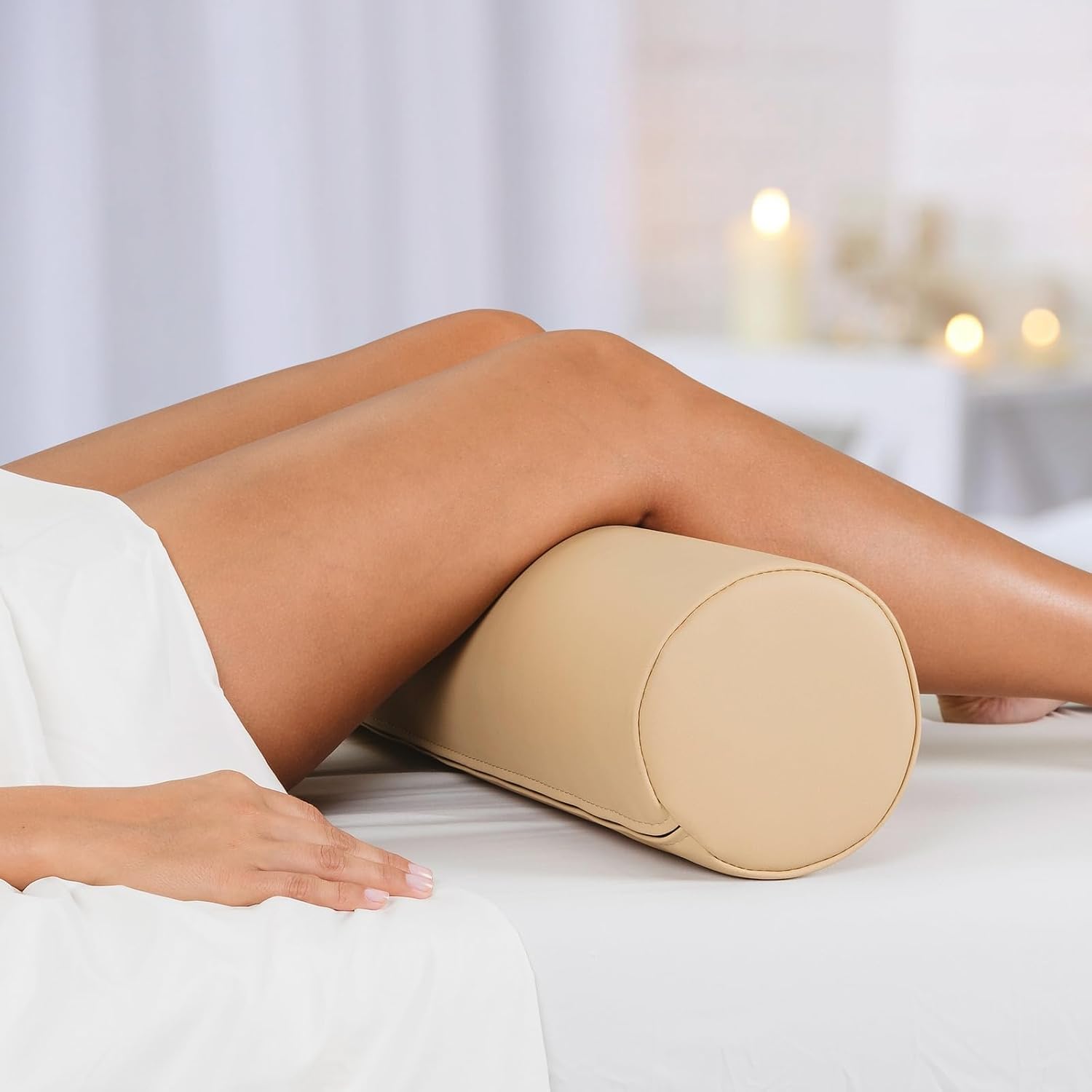
A bolster — the padded cylinder, wedge, or half-round support you slide under a client’s body — looks simple enough that most practitioners treat all of them as interchangeable. They are not. A bolster is a positioning tool, and positioning is clinical. Put the wrong shape under the wrong joint in the wrong modality, and you’re fighting your own setup: lumbar tissue won’t release under effleurage if the spine is hyperextended, a pregnant client’s round ligaments are stressed if the belly isn’t fully offloaded, and your own wrists take the compensatory load when a client’s body isn’t properly supported. The right bolster in the right place does half your work before you touch the client. This guide breaks it down modality by modality — what shape, what diameter, what placement, and why the tradeoffs matter.
| EDITOR'S PICK[EarthLite Massage Bolster Pillo…](https://www.amazon.com/dp/B011QMMAT4?tag=greenflower20-20) | Mid-tierEarthLite Massage Bolster Pillo… | Budget pick[ForPro Full Round Bolster Pillow](https://www.amazon.com/dp/B00E4FKKJI?tag=greenflower20-20) | |
|---|---|---|---|
| Dimensions | 29"L x 9"W x 4.5"H | — | 6"R x 26"L |
| Shape | Half Round Jumbo | Full Round | Full Round |
| Material | — | 100% PU Upholstery | Oil/Stain-Resistant |
| Strap Handle | — | ✓ | — |
| Color | Vanilla Crème | Mystic Blue | Black |
| Price | $49.99 | $44.99 | $26.99 |
| See on Amazon → | See on Amazon → | See on Amazon → |
Why Shape and Density Both Matter (and Why They’re Often Mismatched)
Bolsters come in four primary geometries: full round (cylindrical, typically 6–8 inches in diameter), half round (flat on one side, round on the other — more stable, lower profile), wedge (a foam triangle used for inclined support), and specialty shapes like the side-lying body pillow or the prone pregnancy cutout cushion. Each shape creates a different joint angle, and joint angle determines whether soft tissue is in a lengthened, neutral, or compressed position.
Density compounds this. A bolster that compresses flat under a 180-pound client in supine isn’t supporting the lumbar curve — it’s decorative. Foam density is measured in pounds per cubic foot (PCF); professional bolsters typically run 1.8–2.5 PCF for the inner core, with a higher-density outer layer. Owners of Custom Craftworks bolsters consistently report that the dual-density construction holds its profile after years of daily use, while single-density foam bolsters from budget suppliers flatten noticeably within six to twelve months according to aggregated practitioner reviews on bodywork supply forums. Manufacturer spec sheets for Oakworks and Custom Craftworks both publish their foam PCF ratings — check them before you buy.
By the numbers:
- Standard full-round bolster diameter: 6 in (low-loft, used under knees) to 8 in (high-loft, under ankles/neck)
- Half-round diameter: 3–4 in — roughly half the flex angle of a full round
- Wedge incline angles: 15°, 30°, and 45° are the three most common cuts
- Useful bolster lifespan at daily clinical volume: 2–4 years (foam core); covers replaceable annually or as needed
Swedish and General Relaxation: The Baseline Setup Most LMTs Get Wrong
Swedish massage — the foundational full-body protocol most LMTs learned first — has a deceptively simple positioning requirement, and the most common error is under-supporting the prone position. The standard placement is a 6-inch full round under the ankles in prone and under the knees in supine. Here’s the tradeoff practitioners miss:
Prone: The bolster under the ankles takes the toe-pointing load off the gastrocnemius and soleus (calf muscles) and prevents plantar flexion fatigue during long sessions. If you skip it or use a flat pillow, clients with tight calves or Achilles issues will guard — and you’ll feel that tension travel all the way up the posterior chain. An 8-inch round elevates too high and tilts the pelvis anteriorly, which compresses the lumbar. Stay at 6 inches unless your client is notably tall or has significant lower-leg girth.
Supine: Under the knees, the bolster softens the lumbar curve, reducing tension on the iliopsoas (the deep hip-flexor muscle connecting the lumbar spine to the femur). A half-round works well here for clients with mild lumbar lordosis (exaggerated inward curve) because the lower profile doesn’t push the knees as high, keeping the pelvis from tilting too far posteriorly. ABMP’s Body Mechanics and Self-Care Guide specifically flags over-elevation of the knees as a common contributor to posterior pelvic tilt that paradoxically increases therapist effort on lumbar work.
Prenatal Massage: Where Improvisation Becomes a Liability
This is the modality where bolster choices have direct clinical stakes. After the first trimester, supine positioning is contraindicated for extended periods — the weight of the uterus compresses the inferior vena cava (the major vein returning blood to the heart), which can cause maternal hypotension (sudden drop in blood pressure) and reduced fetal circulation. The standard of care, per AMTA’s Scope of Practice and Standards document, is side-lying positioning throughout the second and third trimester.
A side-lying setup requires at minimum:
- A full-round bolster (6–8 inch) between the knees to keep the top hip from dropping and internally rotating — this protects the sacroiliac joint (the junction between the sacrum and pelvis) and prevents sciatic compression
- A second full-round or body pillow supporting the anterior abdomen — not to restrict movement but to remove the gravitational pull on the round ligaments (the ligaments suspending the uterus)
- A standard pillow or folded bolster under the head to keep the cervical spine (neck) neutral
The most common error: using a single small bolster between the knees and nothing under the belly. The knee bolster alone doesn’t resolve round ligament stress. Practitioners who specialize in prenatal work consistently invest in a dedicated side-lying body pillow — a long, contoured cushion that runs from the head to below the belly in one unit — rather than improvising with three separate standard bolsters. Custom Craftworks and Oakworks both publish prenatal-specific positioning guides alongside their specialty bolster product lines; those documents are worth downloading before you spec your prenatal setup.
NCBTMB’s continuing education standards classify prenatal massage as a specialty area requiring additional training precisely because the positioning requirements differ materially from general Swedish — and the bolster selection is a direct extension of that training.
Deep Tissue and Sports Massage: Lower Profile, Firmer Density
Deep tissue work — and sports massage focused on specific muscle groups — often benefits from reduced bolster height compared to relaxation protocols. Here’s the mechanical reason: when you’re applying sustained, directional pressure (stripping the iliotibial band, for example, or working the erector spinae in prone), you want the client’s body on a relatively flat plane so your body weight travels straight down through your hands. A high bolster under the ankles in prone lifts the lower extremities and tilts the pelvis, which rotates the lumbar away from flat and changes the tissue tension you’re working against.
For deep tissue prone work, many experienced practitioners drop to a 3–4 inch half-round under the ankles rather than a 6-inch full round. The half-round still takes the toe-pointing strain off the calves but doesn’t create the pelvic tilt. Massage Magazine’s positioning fundamentals coverage notes that some deep tissue specialists remove the ankle bolster entirely for specific hip-extensor work, accepting the brief plantar flexion tension in exchange for full posterior chain access.
Density matters even more here. A soft, low-density bolster compresses under a practitioner’s forearm or elbow during assisted-stretch work and stops doing its job. If you’re doing sports massage with active or passive ROM (range-of-motion) components, your bolsters need to hold their shape under 30–50 pounds of localized pressure. Published specs from professional-grade suppliers put this in the 2.2–2.5 PCF range for the core foam.
Hot Stone Massage: The Underrated Positioning Complication
Hot stone protocol introduces a variable most bolster guides ignore: heat transfer. Standard foam bolsters absorb and retain heat unevenly. When a basalt stone is placed on a draped client who is positioned over a foam bolster, the bolster can trap heat against a joint or bony prominence (the knee, the ankle, or the sacrum in supine), increasing burn risk in areas that are already compressed against an uneven surface.
The practical solution is two-part. First, use lower-profile positioning in hot stone sessions — a half-round under the knees in supine rather than a full round — to reduce the compressed surface area at the popliteal (back of the knee) region. Second, consider washable bolster covers with a terry or thick flannel outer layer, which absorb minor heat conduction better than PU (polyurethane) vinyl covers. Most professional bolster covers are vinyl for easy sanitizing — which is correct for infection control — but in hot stone work, a cotton terry over-cover (removed and laundered between sessions) adds a meaningful buffer layer.
Spa Trade’s equipment coverage has noted that resort spas running high-volume hot stone protocols often keep a dedicated set of bolsters with cotton covers specifically for stone work, separate from their vinyl-covered general inventory.
Lymphatic Drainage: Elevation Is the Whole Game
Manual lymphatic drainage (MLD) — a light-touch technique that stimulates the lymphatic system to move excess fluid — depends almost entirely on gravity and joint angle. Unlike Swedish or deep tissue, the pressure used in MLD is featherlight (typically under 40 mmHg). The bolster’s job is purely positional: create the angles that let lymph flow toward functional lymph node clusters.
This typically means elevation, not cushioning. For lower-extremity MLD, the legs are raised above the level of the heart — a 30–45° incline. A wedge bolster (30° or 45° cut) under the lower leg accomplishes this without requiring the client to hold the position actively. For upper-extremity MLD, a wedge under the arm at roughly 30° elevation is the standard configuration.
The tradeoff versus other modalities: for MLD, foam density is less critical than wedge angle precision. A wedge that compresses flat defeats the purpose. Look for firm, high-density foam (2.2+ PCF) in a wedge format, and verify the published angle — some budget wedges are labeled “30 degrees” but cut closer to 20 degrees. Practitioners who’ve cross-trained in lymphatic drainage through NCBTMB-approved CE programs consistently note that their first purchase post-certification is a firm 30° and 45° wedge pair, because the full-round bolsters from their general kit don’t provide reliable, stable elevation.
The Decision Matrix: If X, Then Y
If you run one primary modality (general Swedish, relaxation), your baseline kit — 6-inch full round (×2), half-round (×1) — covers 90% of sessions. Invest in density over variety.
If you’re adding prenatal to your scope, a dedicated side-lying body pillow is not optional. Don’t improvise with general bolsters for regular prenatal clients; the positioning difference is clinically meaningful, and AMTA’s standards documentation supports it.
If you’re moving into deep tissue or sports work, downsize your ankle bolster to a half-round and verify your bolsters’ core PCF rating. If the supplier won’t publish it, that’s your answer.
If you’re spec’ing a hot stone service — whether as a solo practitioner or a spa director purchasing for a multi-table room — budget for dedicated washable over-covers and consider a separate lower-profile bolster set for stone protocols.
If lymphatic drainage is your CE direction, your first accessory purchase should be a firm wedge pair (30° and 45°), not additional round bolsters. The technique requires elevation infrastructure that round bolsters can’t reliably provide.
Bolsters are a small line item in your equipment budget. They’re not a small variable in your clinical outcomes — or in the wear on your own body over a 20-year career. Get the shapes right for what you actually do, and your table becomes a system instead of a surface.