You just passed the MBLEx — the licensure exam that certifies you as a massage therapist in most U.S. states. Congratulations. Now comes the question nobody warned you about in school: what table do you actually buy? A massage table is the single most consequential piece of equipment in your practice. It determines how long your body holds up through six, eight, or ten sessions a day. It affects how safe your clients feel on the table. And a poor choice can mean $300 wasted on something you’ll outgrow in eight months — or worse, a table that contributes to the shoulder and low-back injuries that end careers prematurely. This guide walks through every key spec in plain language, names the tradeoffs honestly, and ends with a clear decision rule so you can stop second-guessing and start booking clients.
The Two Numbers That Actually Matter: Working Load vs. Static Load
This is the most misunderstood spec in the category, and the ABMP’s equipment guidance flags it as a real liability issue for new practitioners — so let’s clear it up before you look at a single product listing.
Static load (sometimes called “safe static load”) is the maximum weight the table can support when nothing is moving. Think of it as the table sitting still in a showroom with a weight placed on it. Manufacturers love to advertise this number because it sounds impressive — you’ll see figures like 2,000 lbs. on budget tables.
Working load (also called “dynamic load” or “recommended working capacity”) is the weight the table is rated to safely bear during actual use — with a practitioner leaning body weight into strokes, a client shifting position, and the table absorbing repetitive lateral force. This number is always substantially lower than the static load, and it’s the one that matters for your practice and your liability.
Per ABMP’s published equipment standards, the working load is the figure practitioners should match to their client roster. If you regularly work with bariatric clients or clients over 300 lbs., a table with a 450 lb. working load is a clinical necessity, not an upgrade. Budget tables in the $150–$250 range frequently omit the working load figure entirely — a red flag.
By the numbers — entry to mid-range portable tables:
| Price Range | Typical Working Load | Typical Weight | Cable System |
|---|---|---|---|
| $150–$299 (budget) | 300–350 lbs. | 28–35 lbs. | Single aircraft cable |
| $300–$499 (entry pro) | 400–450 lbs. | 26–32 lbs. | Double aircraft cable |
| $500–$1,200 (mid pro) | 450–600 lbs. | 24–30 lbs. | Double + reinforced |
Source: Published manufacturer specifications for Earthlite, Sierra Comfort, Custom Craftworks, and Oakworks portable lines, cross-referenced May 2026.
Upholstery: The Spec That Predicts Whether Your Table Lasts Two Years or Ten
New practitioners almost universally underweight this. The foam and the frame are reasonably similar across tables in the same price tier. The upholstery is where you feel the difference at year two, not at unboxing.
Professional-grade upholstery is rated using the Wyzenbeek test — a standardized abrasion measurement (per the American Society for Testing and Materials’ ASTM D4157 protocol) that counts how many double-rub cycles the vinyl survives before showing wear. Budget tables rarely publish this number. Mid-range and professional tables from Earthlite and Oakworks typically publish Wyzenbeek ratings in their spec sheets; look for a minimum of 100,000 double rubs for clinical use.
What this means in practice: budget vinyl at under 50,000 double rubs starts to crack, pit, and peel within 18–24 months of regular use, especially at the face cradle joint and along the table edges where clients pivot getting on and off. Once the vinyl cracks, you have two problems — sanitation (cracked upholstery cannot be adequately disinfected per standard infection control protocols) and professional appearance. Both affect your ability to retain clients.
Practitioners in AMTA’s practitioner community forums consistently report that upholstery failure — not frame failure — is the first reason a budget table is retired. If you’re building a practice you intend to keep, factor replacement cost into your year-one math.
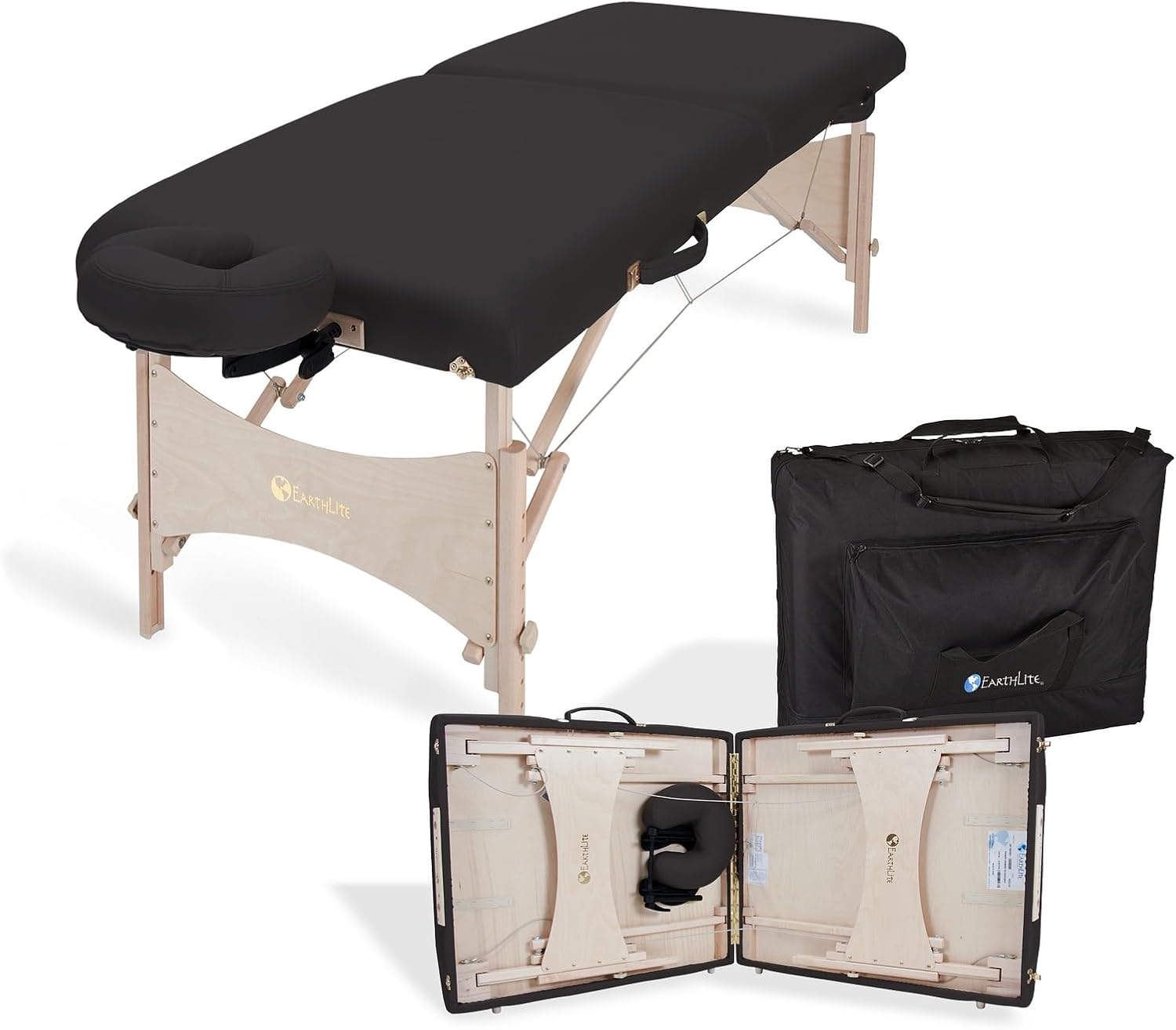
The practical rule: If your budget is genuinely under $300, the Earthlite Harmony DX is the consensus recommendation in this price band. It publishes its upholstery specs, uses a genuine aircraft-aluminum frame, and has a 550 lb. working load. Owners report the face cradle platform is stable and doesn’t wobble during face-down work. It is not a forever table, but it is a honest, entry-level table. Sierra Comfort tables in this range are widely used in massage school clinics and are serviceable for early-career use — reviewers note the upholstery is thinner than Earthlite’s at the same price point.
Table Height and Your Body: The Spec That Ends Careers
Massage Magazine’s ergonomics research is unambiguous: working at the wrong table height is the leading biomechanical cause of career-ending shoulder, wrist, and low-back injuries among massage therapists. Yet most new practitioners set their table height once at school and never reassess it.
The standard ergonomic guideline — published in NCBTMB’s Standards of Practice and reinforced by every continuing education ergonomics course — is that table working height should allow you to maintain a neutral spine with soft knees while your fingertips rest flat on the table surface. This will be a different height for a 5’2” therapist than for a 6’1” therapist, and it will also shift depending on the modality you’re practicing (deep tissue work requires a lower table; energy work or lymphatic drainage may favor a slightly higher surface).
Height range is therefore a buying spec, not an afterthought. Entry and mid-range portables typically offer adjustment ranges from 24” to 34” (low end) up to 27” to 36” (broader range). For therapists under 5’4”, verify that the low end of the adjustment range genuinely reaches your working height — some tables advertise a 24” low but the feet don’t compress cleanly to that measurement with a full client load on the table.
Face cradle compatibility is the overlooked companion to this spec. Face cradles are not universally interchangeable across brands. This is the number-one reason accessory returns happen in this category. If you purchase a table from one manufacturer and then try to add a different brand’s face cradle because it’s cheaper or better-reviewed, you will frequently find platform width, post diameter, or locking mechanism incompatibilities. The safest first-purchase approach is to buy the face cradle from the same manufacturer as your table, or verify compatibility explicitly in the spec sheet before ordering a third-party option.
Matching the Table to Where You Actually Work
Your working context should drive the decision more than any single spec.
If you’re doing mobile/outcall work — going to clients’ homes, hotel rooms, or corporate offices — portability is genuinely load-bearing. The relevant specs here are carry weight (you want under 30 lbs. ideally, under 35 lbs. acceptable) and carry case quality. Earthlite’s carry cases are consistently praised by mobile practitioners for padding and strap design. Budget table carry cases frequently have thin nylon and flimsy zippers that fail within six months of weekly transport. This is not a minor inconvenience — a case failure means an unprotected table frame getting scraped against doorframes and car interiors, which damages the hinge mechanism and voids most manufacturer warranties.
If you’re renting booth space at a spa or multi-table studio — where the table stays in one place most of the time but needs to move occasionally — weight matters less and upholstery quality matters more. You’re not hauling it weekly, but you are subjecting it to 30–50 sessions per week with clients who will wear lotion, sunscreen, and street clothes onto the surface. This is where the upholstery Wyzenbeek rating pays for itself.
If you’re building toward a permanent treatment room within 12–18 months — the honest advice is to buy the best portable you can afford now with the understanding that it becomes your outcall table when you go stationary. Custom Craftworks’ Athena and Oakworks’ Wellspring are both strong mid-range performers in the $500–$800 range that practitioners report using daily for 5+ years. They hold resale value well enough that you can offset the cost of your stationary table purchase later.
The Decision Rule
If budget is the primary constraint and you need a table within the next 30 days: the Earthlite Harmony DX is the entry-level benchmark. It is not the most sophisticated table in the room, but it is the most honest value in the under-$400 band based on published specs and practitioner consensus across AMTA and ABMP community feedback. Buy the matching face cradle and carry case from Earthlite at the same time.
If you can stretch to the $500–$800 range and you’re doing more than 10 sessions per week: Custom Craftworks Athena or Oakworks Wellspring represent the mid-range sweet spot. The upholstery step-up is measurable, the working load headroom is meaningful, and the ergonomic adjustment range is wider. Owners in long-run reviews consistently note that the face cradle system on both tables is more stable during sustained face-down work than anything in the entry tier.
If you’re doing specialty work — prenatal, hot stone, or any modality requiring a table that lies flat without a center seam creating pressure points — verify that the table you’re considering is rated for that specific modality. Not all portables are designed for consistent heat (hot stone) or the lateral loading patterns of prenatal side-lying bolster positioning. This is a spec conversation to have with the manufacturer directly, and your CE course instructor should have an equipment list that goes with your new modality certification. Per NCBTMB’s Standards of Practice, equipment adequacy is a practitioner responsibility — “I didn’t know” is not a defense if a client is injured on an improperly rated table.
Your license took months of work and real money to earn. The table you carry it into practice on deserves at least one afternoon of honest spec comparison. Do that work once, buy it right, and then focus on what you actually trained for.