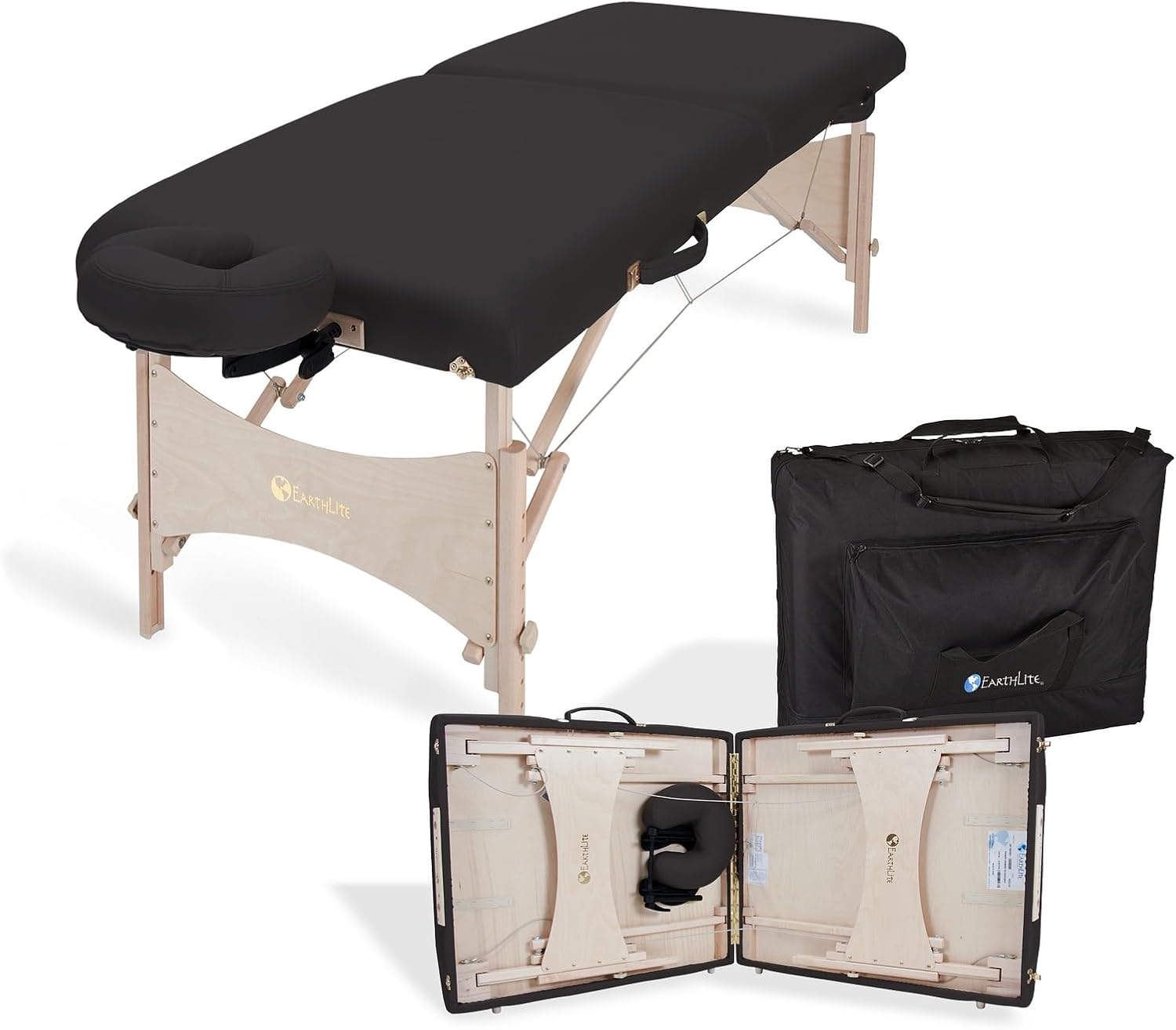
You’ve been doing general Swedish massage for a year and business is good — but your client list is shifting. Athletes, weekend warriors, and chronic-tension clients are booking in, asking for deeper pressure and more active positioning. You pull up your current portable table’s spec sheet and wonder: can this thing actually handle it?
That question matters more than most practitioners realize early on. A portable massage table is — at its core — a weight-bearing platform. It has a working load rating (the maximum client weight it’s designed to safely support during active, dynamic pressure — meaning a practitioner leaning in hard) and a static load rating (the higher number reflecting passive, still weight alone). Deep tissue and sports massage work amplifies the forces on a table’s frame because you’re applying sustained, directed pressure rather than gentle effleurage. Get this wrong and you’re not just looking at a broken table — you’re looking at a liability event. This guide walks through every spec that separates a general-purpose portable from one genuinely built for high-demand bodywork.
Working Load vs. Static Load: The Spec Most Buyers Ignore
This is the most misunderstood number in the portable table market, and for deep tissue practitioners it’s the number that counts.
Static load is what the table can hold when weight is simply resting on it — no movement, no applied force. Many budget tables advertise a 500 lb. or even 600 lb. static load rating, and that sounds reassuring. Working load is the manufacturer’s rating for dynamic use: a client on the table while a practitioner applies active pressure, leverages body weight, or repositions limbs. Working load is almost always lower — sometimes dramatically so.
Per ABMP’s table safety guidance, practitioners should select a table whose working load rating exceeds their heaviest anticipated client weight by a meaningful margin — the commonly cited rule of thumb is at least 50 lbs. of headroom. For deep tissue work specifically, the practical recommendation is to treat working load as your binding constraint, not static load.
Here’s why it matters in practice: when you sink into a client’s erector spinae with a forearm or drive through a hip with your body weight, you’re generating peak forces that can briefly double the effective load on the table’s legs and frame joints. A table rated for 450 lb. working load with an aluminum A-frame and steel cable support system is engineered for that scenario. A table rated for 450 lb. static load with a lighter cable and wood frame may be technically within spec when a client lies still — and outside it the moment you lean in.
The practical floor for deep tissue and sports work: Look for a working load rating of 450 lbs. or higher. Tables in the $500–$1,200 mid-range from Custom Craftworks, Oakworks, and Earthlite consistently hit this threshold with documented specs. Entry-level tables in the $150–$400 range often do not.
Frame Construction and Leg System: Where Portables Fail Under Pressure
Not all portable frames are created equal, and the differences show up under deep tissue load.
Wood vs. Aluminum Frames
Most professional-grade portables use either hardwood (typically maple or beech) or aircraft-grade aluminum frames. Each has a different failure mode:
-
Hardwood frames are heavier (typically 30–40 lbs. for a full-size table) and absorb vibration well, which many practitioners prefer for feedback during deep tissue work. The tradeoff is that wood joints — especially the cable anchor points and leg pivot hardware — can loosen with repeated heavy use if not maintained. Custom Craftworks’ Omni series spec sheets note their maple frames are engineered specifically for sustained-pressure modalities, and practitioners doing regular deep tissue work report strong long-term satisfaction with wood construction when the hardware is checked periodically.
-
Aluminum frames are lighter (often 25–32 lbs.) and structurally less prone to the joint-loosening problem, but some practitioners report a slightly more rigid feel underhand. Earthlite’s ELEMENT series uses aluminum construction rated at 450 lb. working load and has a strong reputation among sports massage practitioners who value the carry weight advantage — particularly those doing on-site athletic event work.
Cable Tension and Leg Spread
The steel cables running diagonally beneath most portables are load-critical components. Wider leg spread distributes weight across a broader base and reduces lateral flex when a practitioner pushes across the table. Look for adjustable leg spread (sometimes called “variable leg angle”) and verify the cable is rated and replaceable — not a fixed stamped component.
A narrower leg stance is a common cost-reduction feature on budget tables. It’s fine for gentle modalities. For sports massage work where a practitioner may be pushing a leg into abduction or driving through a hip, it creates noticeable sway that breaks your mechanical advantage and fatigues you faster.
Table Width, Padding Density, and Upholstery: The Overlooked Performance Variables
Width
Standard portable tables run 28–30 inches wide. For deep tissue and sports massage, width works against you in a specific way: the wider the table, the more you have to reach, the worse your leverage, and the higher your injury risk. AMTA’s ergonomics guidance consistently identifies overreaching as a primary contributor to practitioner shoulder and low-back injuries.
For deep tissue practitioners, 28 inches is the working sweet spot. It keeps the client within your mechanical advantage zone without requiring you to lean across. Wider tables (30–32 inches) are better suited for larger clients in relaxation-focused work where you’re not driving pressure from above.
Padding Density
This is where marketing language diverges from clinical reality. “Plush” padding — often 3–4 inches of soft foam — feels luxurious during a Swedish massage. Under deep tissue pressure, it compresses and destabilizes the client. You lose proprioceptive feedback (your tactile sense of tissue depth) and the client’s body shifts rather than responding to your input.
For deep tissue and sports work, look for 2–2.5 inch high-density foam with a firmness rating in the medium-firm range. Some manufacturers offer dual-layer construction — a firm base layer topped with a thinner comfort layer — which is the best-of-both compromise. Oakworks’ portable lines note this construction approach in their spec documentation, and practitioners doing mixed modality work — including both relaxation and deep tissue in a single day — consistently cite it as the preferred configuration.
Upholstery Durability
Upholstery is the highest predictor of table lifespan in high-use scenarios, and sports and deep tissue work accelerates wear because clients are often less draped, may be perspiring (athletic clients post-event especially), and sessions involve more friction from repositioning. Look for PU (polyurethane) vinyl rated for at least 250,000 Wyzenbeek cycles — this is the industry standard threshold for commercial durability. Budget tables frequently use thinner vinyl that begins cracking or delaminating within 2–3 years of daily use. Earthlite and Oakworks both publish Wyzenbeek ratings in their product documentation; if a manufacturer doesn’t list this spec, treat it as a red flag.
By the Numbers: Key Specs for Deep Tissue–Ready Portables
| Spec | Minimum for Deep Tissue Work | Where Budget Tables Often Fall Short |
|---|---|---|
| Working load rating | 450 lbs. | Often unlisted or conflated with static load |
| Table width | 28–30 in. (28 preferred) | Budget tables often widen to appear premium |
| Foam density | 2–2.5 in. high-density | Budget tables use 3+ in. soft foam |
| Upholstery durability | 250,000+ Wyzenbeek cycles | Rarely published; wear begins at 1–2 years |
| Frame weight (portability) | 30–38 lbs. full kit | Heavier wood frames add 5–8 lbs. |
Face Cradle and Accessory Compatibility
This one catches practitioners by surprise every time: face cradles are not universal. The mounting hardware varies by manufacturer, and a face cradle from one brand frequently won’t seat properly — or at all — on a table from another. ABMP member forums and practitioner consensus on equipment boards consistently cite face cradle incompatibility as the number one return reason for portable table accessories.
For sports and deep tissue work, the face cradle isn’t optional — you’ll have clients in prone position for extended periods of sustained pressure work, and a cradle that doesn’t lock firmly becomes a liability. Before buying any portable table:
- Verify face cradle is included in the package, not sold separately.
- Check that replacement cradles from the same manufacturer are available and in stock (supply chain disruptions in 2024–2025 created inventory gaps that some smaller brands still haven’t fully resolved as of mid-2026).
- If you’re adding a tilting face cradle for side-lying sports massage positioning, confirm compatibility in writing with the retailer — not just by assuming it fits.
Height Range and Ergonomic Fit
The AMTA’s injury prevention resources identify working at the wrong table height as the leading mechanical cause of career-ending shoulder and back injuries among massage therapists. Deep tissue work compounds this: you’re leveraging gravity and body weight rather than arm strength, which means even a 1–2 inch height error removes your mechanical advantage and forces muscular compensation.
The clinical rule: your table height should allow a soft fist to clear the tabletop surface with your arm hanging straight at your side, knuckles just touching. For deep tissue and trigger point work, you may want the table 1–2 inches lower than this baseline to increase your downward leverage.
Look for a height adjustment range of at least 23–33 inches (some tables extend to 36 inches). This range accommodates both short and tall practitioners working across client body types without requiring awkward cable re-threading. Tables with tool-free leg adjustment (lever or clamp systems rather than bolt-and-wing-nut) allow mid-session micro-adjustments — a feature practitioners doing sports massage with active stretching components report as genuinely useful, not just a marketing add-on.
The Decision Rule
Here’s the honest framework based on published specs and practitioner-reported patterns:
If you’re doing more than 30% deep tissue or sports massage volume and working from a portable, the entry-level tier ($150–$400) is likely undersized for your actual working conditions. The working load headroom, foam density, and upholstery durability specs at that price point are optimized for lighter modalities.
If your volume justifies a mid-range portable ($500–$1,200), tables in the Custom Craftworks Omni, Oakworks portable, and Earthlite ELEMENT class consistently meet the spec thresholds outlined here — working load at or above 450 lbs., documented upholstery ratings, and height ranges that support proper ergonomic setup for high-pressure work.
If you’re doing sports massage at athletic events or building a mobile clinical practice, weight becomes a genuine constraint alongside durability. In that scenario, the aluminum-frame options in the same price tier earn their premium over wood through carry-weight savings that compound across a multi-event season.
The table is your primary clinical tool. For deep tissue and sports massage, it’s also a load-bearing partner in every technique you execute. Matching the spec to the modality isn’t a fine point — it’s the foundation everything else is built on.