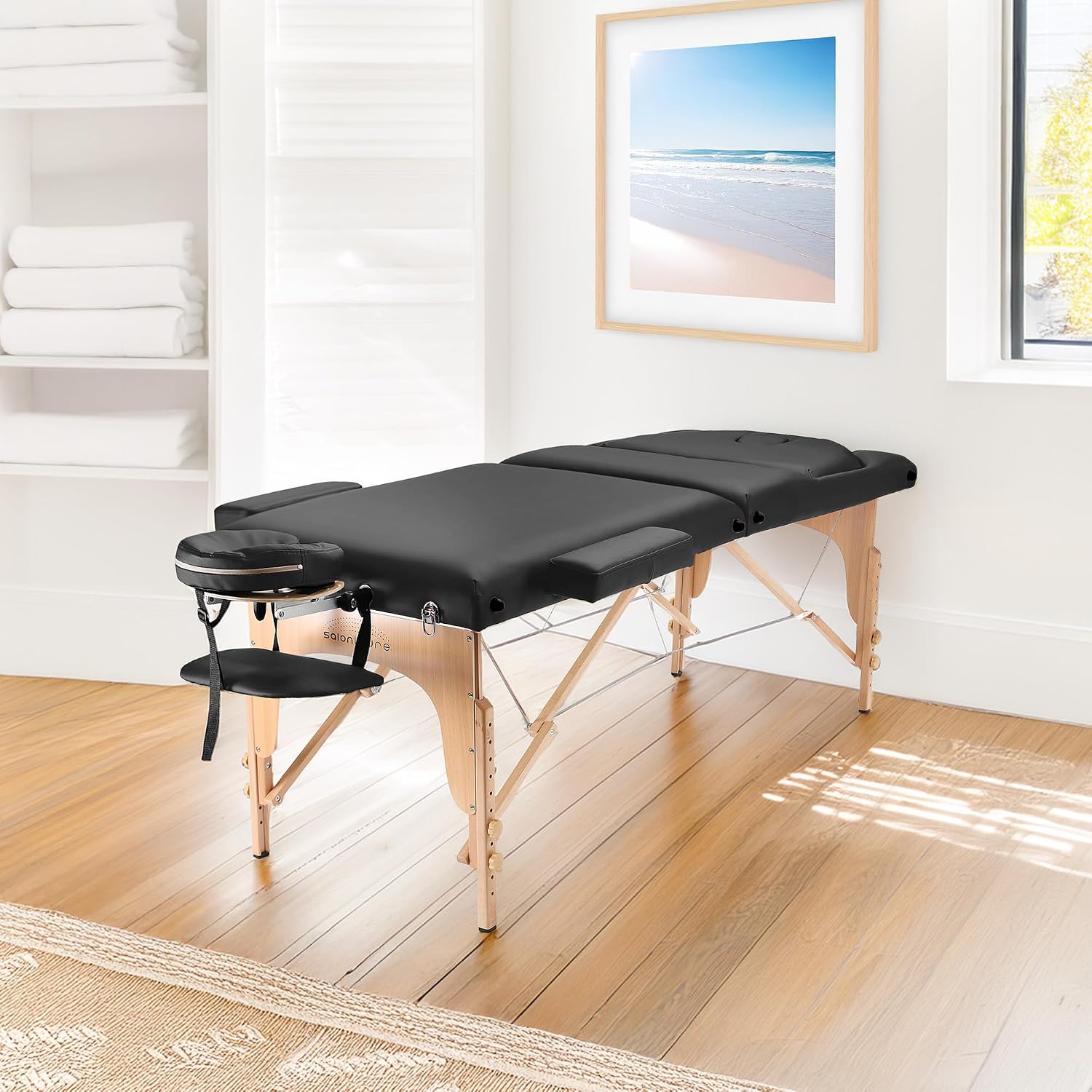
You just got your esthetics license — or maybe you’re a lash artist booking out two weeks in advance and finally setting up a dedicated space. You search “portable treatment table” and land on a sea of options that all look more or less identical: padded surfaces, folding legs, adjustable height. Many of them are marketed to massage therapists. So the question is reasonable: can you just buy the same table an LMT uses?
Sometimes yes. More often, no — and the mismatch costs you in client comfort, workflow efficiency, and occasionally in your own body. A massage table (the platform a licensed massage therapist uses for Swedish or deep tissue work) is engineered around a specific set of demands: a working load (the dynamic force generated by therapeutic bodywork strokes, typically rated higher than simply lying still) of 450–600 lbs on quality portable models, a width optimized for practitioner reach, and a face cradle cutout for prone positioning. An esthetic or treatment table is built around a different workflow — the client is mostly supine (face-up) and stationary, the practitioner sits or stands close to the face and upper body, and the modality tools (steamers, ring lights, tattoo machines) create ergonomic demands the average LMT never encounters. This article breaks down exactly where the specs diverge, what to prioritize by modality, and how to make a confident buying decision without paying for engineering you don’t need — or skipping specs you do.
| EDITOR'S PICK[Saloniture Professional Portabl…](https://www.amazon.com/dp/B00IMKSYTO?tag=greenflower20-20) | Mid-tier[Masajeo Portable Lash Bed for L…](https://www.amazon.com/dp/B0CGVDKFXQ?tag=greenflower20-20) | Budget pick[Therapist®s Choice® Standard Un…](https://www.amazon.com/dp/B003EMSLN4?tag=greenflower20-20) | |
|---|---|---|---|
| Type | Portable massage table | Portable lash/spa bed | Face cradle only |
| Adjustable Height | — | ✓ | — |
| Face Cradle | — | — | ✓ |
| Frame Material | — | Aluminum | — |
| Waterproof | — | ✓ | — |
| Price | $176.99 | $145.99 | $20.99 |
| See on Amazon → | See on Amazon → | See on Amazon → |
The Core Spec Differences: Width, Height Range, and Padding Profile
These three variables are where most cross-modality buying mistakes happen.
Width. Standard massage tables run 28–32 inches wide. That width serves the LMT: it keeps the client’s shoulders accessible from a standing position on either side and allows full-stroke reach without the practitioner hyperextending. For estheticians and lash techs, a narrower table — 24–28 inches — is frequently preferred. The reason is simple: you’re working seated, close to the client’s face. A wider table pushes the client’s head farther from your body, increasing your forward lean and loading your lumbar spine over a six- or eight-hour day. Massage Magazine’s ergonomics coverage consistently flags forward trunk flexion as a primary driver of career-ending lower back injury; for seated facial and lash work, table width is a direct variable in that equation.
Height range. LMT tables typically adjust from roughly 24–34 inches. That range is calibrated for standing bodywork — the classic rule of thumb cited by AMTA is knuckle height when standing relaxed. Esthetic and lash work done seated calls for a higher working surface: many practitioners report preferring 30–36 inches so the client’s face clears their own thigh line without hunching. Look for tables that advertise a maximum height of 36 inches or above if seated facial work is your primary modality.
Padding thickness and firmness. Massage tables typically ship with 2.5–3 inches of high-density foam. That density supports therapeutic pressure without the table surface deflecting under bodywork strokes. For esthetic and lash clients, the priority flips — comfort during 60–90 minutes of stillness becomes paramount, and a slightly softer or thicker top layer (3–4 inches, or a dual-density construction) earns better client reviews without any functional downside, since you’re not working against the surface the way an LMT does. That said, don’t go too soft: foam that compresses more than about 30% under body weight creates a “sinking” sensation some clients dislike and makes repositioning awkward during treatment steps.
What Tattoo Artists Need That Neither LMTs Nor Estheticians Prioritize
Tattoo work introduces two spec requirements that rarely appear in massage or esthetics buying guides.
Positional flexibility and armrest compatibility. Tattooing a forearm, calf, or ribcage piece requires the client to hold a fixed position — sometimes an awkward one — for extended periods. A flat, stationary table surface works for back pieces, but for limb and side work, many tattoo artists rely on a table with a backrest section that elevates independently (essentially a reclining table rather than a flat one). These are often marketed as “esthetic beds” or “salon beds” rather than massage tables. The backrest hinge allows the client to sit semi-reclined for sternum or collar work, or fully upright for hand and forearm pieces. If you’re evaluating a flat portable massage table for tattoo work, assess honestly whether your typical placement sites require that flexibility.
Weight capacity with static confidence. Here’s the spec most buyers misread: working load (the dynamic load rating, accounting for the force multiplier of massage strokes) versus static load (the load the table sustains from a client simply lying still). ABMP’s portable table buying guidance notes that manufacturers typically rate working load lower than static load because therapeutic pressure creates momentary force spikes. For tattoo and esthetic work, static load is the more relevant number — clients aren’t generating dynamic forces. This means a table rated for a 450-lb working load likely handles a 550-lb+ static load. But if a client-weight accommodation is your primary concern, ask the manufacturer specifically for the static load rating, not just the headline working load spec. Custom Craftworks and Oakworks both publish both figures in their product documentation; many budget brands publish only one.
By the numbers — portable table spec comparison by modality:
| Spec | LMT (therapeutic massage) | Esthetician / Lash | Tattoo Artist |
|---|---|---|---|
| Ideal width | 28–32 in | 24–28 in | 27–30 in |
| Height range priority | 24–34 in (standing work) | 28–36 in (seated work) | 24–36 in (variable) |
| Padding priority | 2.5–3 in high-density | 3–4 in, softer top layer | 2.5–3 in, firm (client stability) |
| Backrest section needed? | Rarely | Sometimes (facial lift) | Often |
| Face cradle essential? | Yes | Rarely | No |
Upholstery: The Spec That Separates a Two-Year Table From a Six-Year Table
Regardless of modality, upholstery durability is the single highest predictor of table lifespan — and it’s the spec most buyers skip during the purchase decision. The two durability standards to know are Wyzenbeek (an abrasion test common in the U.S., measured in double rubs) and Martindale (the European equivalent, also in cycles). A table upholstery rated at 100,000+ Wyzenbeek double rubs will meaningfully outlast one rated at 40,000 under daily professional use.
For esthetic and tattoo work specifically, there are two additional upholstery concerns massage buyers rarely face:
Chemical resistance. Estheticians routinely apply solvents, exfoliant acids, and oil-based products near the table surface. Many tattoo artists use green soap, petroleum-based barriers, and ink that can transfer. Standard vinyl upholstery holds up reasonably well; polyurethane (PU) upholstery — increasingly common on mid-range and premium tables — offers better resistance to alcohol-based cleaning agents. ASCP’s Skin Deep magazine has noted that practitioners using strong chemical exfoliants report faster upholstery degradation on standard vinyl compared to PU-coated alternatives.
Seam placement. Look at where the upholstery seams run. Center-seam tables (a seam running the length of the table along the client’s spine) create a pressure point for supine clients during long esthetic treatments. Side-seam or seamless-top construction is worth paying a modest premium for in esthetic and lash contexts where clients are motionless for an hour or more.
Face Cradles: Essential for LMTs, Optional (and Sometimes Counterproductive) for Everyone Else
The face cradle — the U-shaped extension at the head of the table that supports the face during prone (face-down) positioning — is non-negotiable for massage therapists. For estheticians and lash techs, it’s often actively in the way.
Facial work is done supine. The face cradle slot at the head of the table serves no function and can create a gap that clients’ heads partially fall into, reducing perceived comfort. Some esthetic tables eliminate the cutout entirely and provide a flat, full-length sleeping surface. Others offer a removable or foldable face cradle that stores cleanly.
If you’re buying a massage-category table for esthetic use, verify that the face cradle detaches fully and that the headplate (the panel that fills the gap when the cradle is removed) is included in the purchase price — on some brands it’s a separate accessory. AMTA’s equipment guidance notes that face cradle compatibility issues are among the most common complaints in accessory returns; the headplate compatibility issue is the flip side of that problem.
Making the Decision: If X, Then Y
If you’re a licensed esthetician doing primarily facial and body treatment work seated, prioritize a table 24–28 inches wide, with a maximum height of at least 36 inches, PU or chemical-resistant upholstery, and a removable face cradle with included headplate. The massage table category has good options, but filter specifically for these specs rather than defaulting to whatever LMT colleagues recommend — their workflow is genuinely different from yours.
If you’re a lash tech doing 60–90 minute lash sets, every spec above applies, and add one more: padding comfort. Your clients are immobile longer than in most massage sessions. A 3-to-4-inch dual-density top layer is worth the upgrade cost — reviewers in the lash community consistently cite client restlessness during long sets as a retention issue tied directly to table comfort.
If you’re a tattoo artist, the backrest-elevation question is the fork in the road. If 70% or more of your placements are back, legs, or chest pieces done on a flat surface, a quality flat portable table with firm padding and chemical-resistant upholstery works well. If you regularly work arms, hands, collar, or ribcage pieces requiring client semi-incline, invest in a reclining esthetic bed from the start — retrofitting a flat table with an aftermarket wedge is a friction solution that clients notice.
If you’re cross-licensed (an LMT who also offers esthetics, or a tattoo artist adding stretch and bodywork services), the compromise table exists: look for a 28-inch wide model with a 36-inch maximum height, a removable face cradle, and PU upholstery. You’ll make small concessions in each modality but avoid owning two full platforms. The working load spec should still meet LMT standards — don’t sacrifice that even if massage is secondary to your practice.
The market at the $300–$700 price point now includes solid options purpose-built or well-adapted for non-massage modalities. The mistake to avoid is buying on price alone and discovering six months in that the table’s width, height ceiling, or upholstery chemistry is working against your body and your client experience. Read the spec sheet against the checklist above before the purchase, not after.