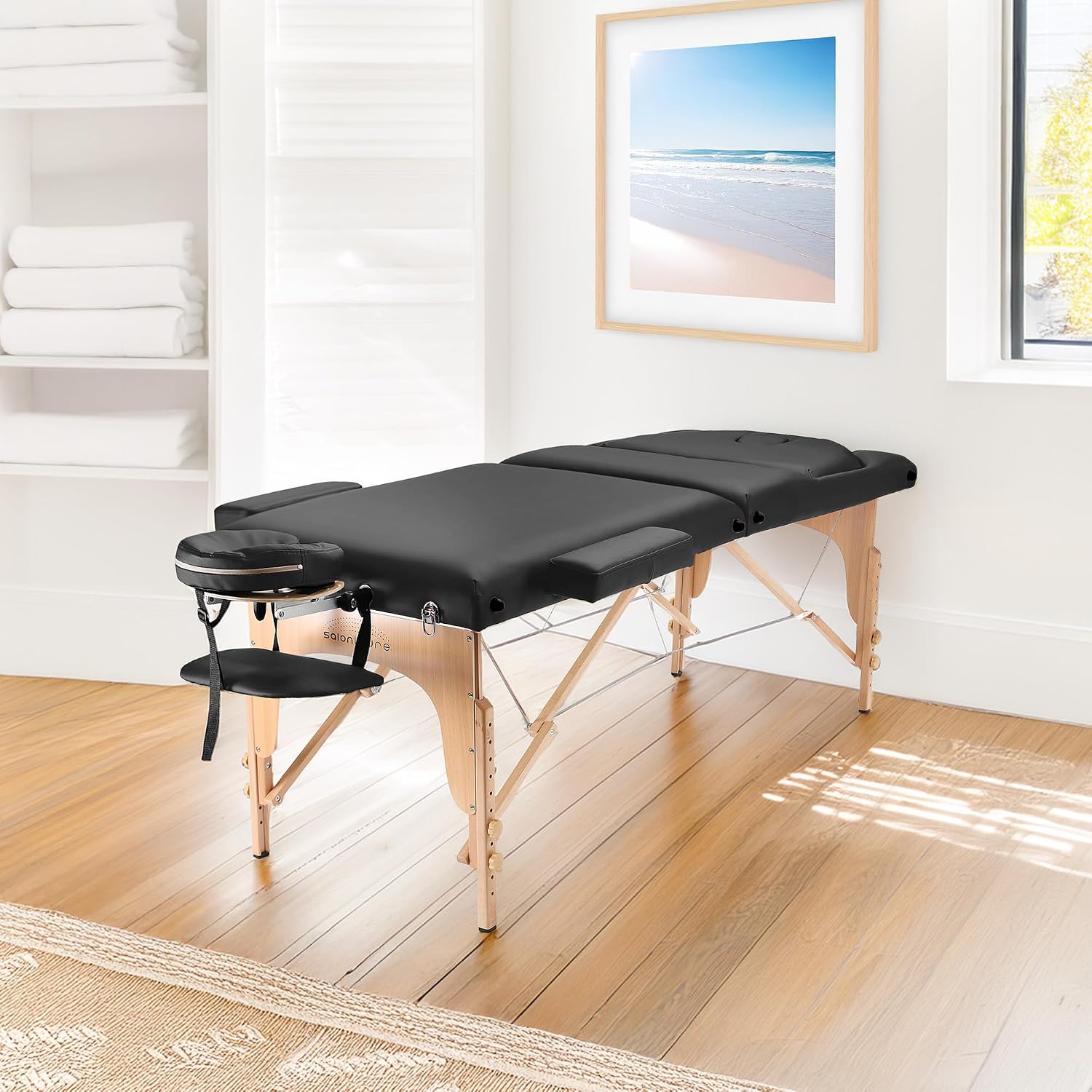
You’ve been practicing for a year or two. Your portable table — the folding kind that fits in a carry bag and travels with you — has served you well. But something is starting to feel off. Maybe your lower back aches after back-to-back sessions. Maybe a client has mentioned the table wobbles slightly mid-session. Maybe you’re renting a room in a clinic now, and the folding legs just look out of place next to everyone else’s gear. Here’s the honest context: portable tables (folding massage tables designed for transport, typically priced between $150 and $500) and stationary tables (fixed-base or electric-lift tables designed to stay in one room, typically $800 to $6,000+) are not just different price points — they reflect fundamentally different assumptions about how, where, and how long you practice. This guide breaks down exactly what changes when you upgrade, which specs actually matter, and when the math makes the move worth it.
| EDITOR'S PICK[EarthLite Sedona Stationary Spa](https://www.amazon.com/dp/B0016JC0MU?tag=greenflower20-20)… | Mid-tier[BestMassage Massage Table Stati](https://www.amazon.com/dp/B00K2OITES?tag=greenflower20-20)… | Budget pick[Saloniture Professional Portabl](https://www.amazon.com/dp/B00IMKSYTO?tag=greenflower20-20)… | |
|---|---|---|---|
| Table width | 32" | 30" | — |
| Table length | 73" | 75" | — |
| Foam thickness | — | 4" | — |
| Stationary use | ✓ | ✓ | ✗ |
| Wood base | Hard Maple | — | — |
| Price | $1,199.00 | $219.97 | $176.99 |
| See on Amazon → | See on Amazon → | See on Amazon → |
The Core Engineering Gap: Why Portables and Stationarys Are Different Machines
A portable table’s entire design premise is the compromise. Every engineering decision — frame weight, leg diameter, hinge construction, foam density — is balanced against one overriding constraint: it has to fold, fit in a bag, and be carried by one person. That’s a genuinely useful product. But it creates structural trade-offs that become liabilities once you’re doing six to eight sessions a day in a fixed location.
Working load vs. static load is the most misunderstood spec in table shopping, and it’s worth defining clearly here. Static load is the maximum weight a table can hold when nothing is moving — it sounds impressive, and manufacturers advertise it prominently. Working load (also called dynamic load) is the maximum weight the table is rated to handle when force is actively applied: a therapist leaning in with body weight, applying deep tissue pressure, performing assisted stretching. A portable table might list a 450-lb static load, but its working load — the number that actually governs your liability and your client’s safety — is often closer to 300 lbs or less. Oakworks’ published Clinician Series spec sheets, for example, list working loads of 600 lbs on their stationary models, a specification that reflects reinforced steel frames and welded (rather than hinged) joints.
Massage Magazine’s buyer guidance on clinical table selection notes that practitioners often discover this gap only after a near-miss incident or when a larger client declines to use their table — an avoidable and professionally damaging situation. The working load number is the one to ask for, not the static load headline.
Beyond load ratings, the second structural difference is torsional rigidity — resistance to twisting. Portable tables flex laterally under directional pressure because hinged legs are, by definition, designed to move. Stationary tables with welded or bolted fixed bases don’t flex. Practitioners who work in proprioceptive neuromuscular facilitation (PNF) stretching, Thai-influenced bodywork, or deep tissue consistently report that the table’s stability directly affects their own technique confidence and body mechanics.
What Electric-Lift Tables Actually Solve (and What They Don’t)
The single clearest argument for upgrading isn’t aesthetics or client perception — it’s practitioner injury prevention. ABMP’s ergonomics guidance for massage therapists identifies working at an incorrect table height as a leading contributing factor in career-shortening injuries, particularly to the lumbar spine, shoulders, and wrists. A flat-height portable, even with good adjustable legs, requires you to stop between clients, crouch down, and manually adjust — meaning most practitioners pick one height and leave it there for the day. That means you’re at the wrong height for roughly half your clients.
An electric lift table (a stationary table with a motorized base that raises and lowers the working surface at the touch of a button or foot pedal) solves this at the structural level. You dial in the precise height for each client’s body type and for each technique in real time. You can lower the table for draping and client positioning, then raise it to protect your own lumbar spine during effleurage sequences. TouchAmerica’s published technical specifications on their electric lift models document height ranges typically spanning from approximately 19 inches to 35 inches, giving practitioners the full ergonomic envelope without any manual adjustment.
The honest counterpoint: electric lift tables are heavy (many run 200–275 lbs), require a nearby power outlet, and represent a significant capital investment. They don’t travel. For a practitioner who still does any mobile or outcall work, they are the wrong primary table. But for anyone operating a fixed treatment room full-time, AMTA’s industry research consistently shows that practitioners who invest in ergonomic setups report longer career longevity and lower rates of repetitive strain injury — a fact worth weighing against sticker shock.
What electric lift tables don’t solve: upholstery quality, face cradle compatibility, or accessory ecosystem — all of which still depend on individual brand and model choices.
By the Numbers: Portable vs. Stationary at a Glance
| Spec | Typical Budget Portable | Mid-Range Stationary (Manual) | Electric-Lift Stationary |
|---|---|---|---|
| Working load | 250–350 lbs | 400–500 lbs | 500–600+ lbs |
| Weight (table only) | 28–38 lbs | 65–90 lbs | 175–275 lbs |
| Height adjustment | Manual leg pins | Manual hydraulic or pin | Motorized (foot pedal / handset) |
| Typical price range | $150–$500 | $800–$1,800 | $2,000–$6,000+ |
| Face cradle system | Brand-specific (often non-universal) | Brand-specific | Brand-specific |
Sources: Published manufacturer spec sheets from Oakworks, Custom Craftworks, and TouchAmerica, cross-referenced with Massage Magazine’s buying guidance.
Upholstery: The Spec That Predicts Lifespan More Than Any Other
Practitioners upgrading from a budget portable table are often surprised by how quickly clinic-volume use destroys inexpensive upholstery. The foam compresses, the vinyl cracks at the stress seams, and the stitching separates — typically within 12–18 months under daily clinical use. This isn’t speculation; it’s a pattern documented across practitioner forums and in Massage Magazine’s long-term table reviews.
The relevant measure is Wyzenbeek rating (a standardized abrasion-resistance test expressed in double rubs — each “double rub” represents one back-and-forth abrasion cycle against a reference fabric). Budget portable upholstery often tests in the 50,000–100,000 double-rub range. Clinical-grade upholstery on stationary tables from Oakworks, Custom Craftworks, or TouchAmerica typically tests at 200,000–500,000+ double rubs. The practical consequence: a clinical-grade table may carry an upholstery warranty of three to five years under commercial use, versus no meaningful warranty on a budget portable’s covering.
For practitioners in spa or resort environments, upholstery selection also intersects with chemical compatibility — specifically, whether the vinyl or polyurethane covering is rated to withstand repeated exposure to massage lubricants, sanitizing wipes, and hospital-grade disinfectants. Oakworks’ published care documentation specifies approved cleaning agents by product line, a level of detail budget tables don’t offer because their coatings aren’t rated for that use pattern.
One operational note worth raising: face cradle compatibility is not universal across brands, and this is the number-one reason practitioners return accessory purchases. The face cradle (the padded, adjustable frame that supports a client’s face during prone — face-down — work) attaches via a brand-specific rail or post system. Oakworks face cradles are not cross-compatible with Custom Craftworks tables, and neither is compatible with most budget portable systems. When you upgrade tables, budget for a new face cradle from the same manufacturer. Mixing systems is the path to unstable fittings and potential client safety incidents.
Making the Decision: An If/Then Framework
Given the investment involved, the upgrade decision shouldn’t be made on aspiration alone. Here’s a decision framework based on the specs and practitioner patterns described above:
If you’re doing five or more sessions per day in a fixed room: The working-load, ergonomic, and upholstery arguments for a stationary table are unambiguous. The math on upholstery replacement alone — two portable table upholstery replacements over three years can run $300–$600 in materials and labor, not counting downtime — begins closing the cost gap with a mid-range stationary. Add in one career-ending shoulder injury and the calculus is not close.
If you’re seeing a mixed clientele with significant body diversity (clients above 250 lbs regularly): A portable table’s working load, not its static load, is a liability issue. This is the scenario where practitioners most often discover the spec gap at the worst possible moment. A stationary table rated to 500 lbs working load removes that risk entirely.
If you’re expanding into specialty modalities — prenatal massage, PNF stretching, lymphatic drainage: Each of these modalities creates specific table demands. Prenatal work benefits dramatically from a cut-out or tilting surface that accommodates a pregnant client lying face-down, a feature available on stationary models from Oakworks and Custom Craftworks but absent on most budget portables. PNF and assisted stretching require the torsional rigidity discussed above. Lymphatic drainage protocols often involve table height adjustments mid-session. These are equipment gaps, not just preference gaps.
If you’re still mobile or hybrid (mix of in-room and house calls): A premium portable — Custom Craftworks or Oakworks portable in the $500–$1,200 range — may be the smarter bridge investment before committing to a stationary. The working-load and frame specs on mid-range portables are meaningfully better than budget entry-level, and you preserve mobility.
If you’re a commercial or institutional buyer — chiropractic office, PT clinic, spa fleet: The conversation shifts to electric-lift tables, fleet pricing, ergonomics certifications, and upholstery warranties under commercial-use terms. TouchAmerica and the Oakworks Pacific and Clinician series are the spec-sheet benchmarks in this tier. AMTA’s industry fact sheet notes that multi-table wellness centers increasingly specify electric-lift tables as a standard of care for both practitioner injury prevention and ADA-adjacent accessibility — the ability to lower a table significantly for clients with mobility limitations.
The Buying Decision
The portable table got you started. That was exactly right. But if you’re reading this because your back aches on Fridays, or a client hesitated before getting on your table, or you’ve started turning away larger clients — those are data points, not bad luck.
A mid-range manual stationary table ($800–$1,800) is the right move for a solo practitioner in a fixed room doing clinical volume. An electric-lift stationary ($2,000–$4,500 for a single-table practice, $3,500–$6,000+ for commercial specs) is the right move once ergonomic precision and client accessibility are non-negotiable. The spec to anchor every comparison on: working load first, upholstery Wyzenbeek rating second, face cradle system compatibility third. Everything else is a feature.
Your table is the tool your hands work from. At the intermediate stage of practice, the question isn’t whether to upgrade — it’s being honest about which of the trade-offs you’re still willing to carry.