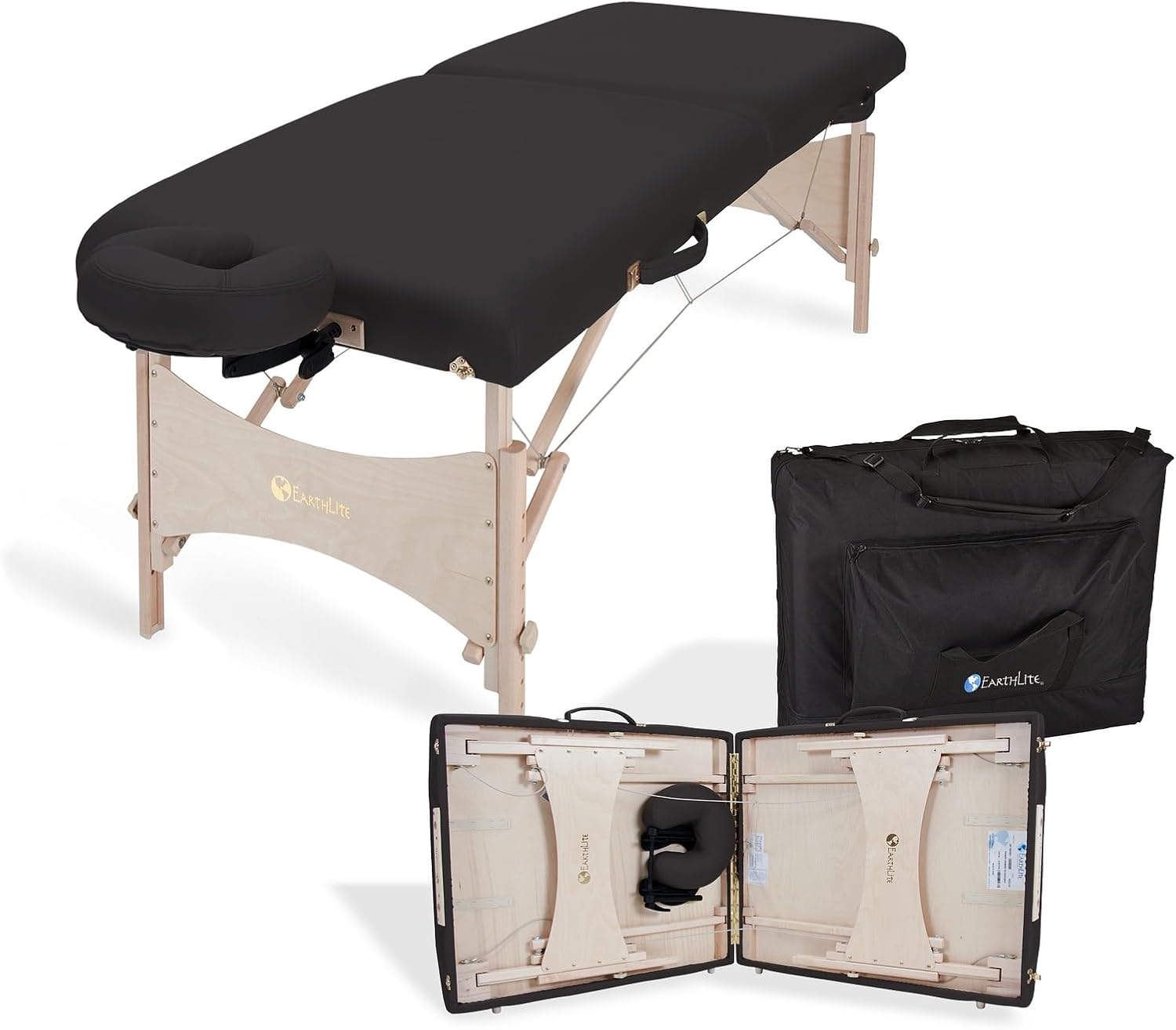
Picture this: you’re 14 months into solo practice. Your schedule finally hit 22 clients a week, your referral pipeline is real, and then you notice it — a faint crack tracing along the face-cradle opening, a dulling sheen where the vinyl has been wiped down a thousand times, maybe a small split at the side seam. The frame is fine. The foam is fine. The upholstery is failing.
This is the single most predictable maintenance story in massage practice, and almost nobody talks about it before the purchase. Upholstery on a massage table is the outer covering — the vinyl or synthetic leather skin that clients lie on, that you wipe with disinfectant after every session, that flexes and stretches as the table is adjusted. It takes the most punishment of any component, and it almost always fails first. This article will show you exactly which specs predict durability, how to read them across brands, and what a high-volume practice actually needs before you spend money on a table — or a re-cover job.
Why Upholstery Fails Faster Than You Expect
The math is straightforward: at 20 clients per week, you’re completing roughly 1,000 sessions per year. Each session involves the client lying down, shifting, being draped, and getting up — that’s mechanical abrasion. After each session, you apply a disinfectant spray or wipe — that’s chemical stress. Winter heating and summer humidity cause the material to expand and contract — that’s thermal fatigue. Do this a thousand times a year, and upholstery that was built for residential furniture (designed for perhaps 20,000 cycles of light use over a decade) collapses fast.
Most entry-level table upholstery in the $150–$400 price band is 1.8mm to 2.0mm PU (polyurethane) vinyl — the same weight class you’d find on a budget office chair. It looks identical to heavier materials in a showroom. You won’t feel the difference until month eight.
The problem isn’t just aesthetic. Cracked vinyl harbors pathogens in ways that intact upholstery does not. Per ABMP’s Equipment & Supply Guidance for Massage Practitioners, cracked or delaminating upholstery surfaces cannot be reliably sanitized with standard EPA-registered disinfectants, because the liquid pools in fissures rather than contacting the full surface. That’s not just an expense problem — it’s a hygiene and liability problem.
The Specs That Actually Predict Durability
Wyzenbeek and Martindale: The Two Abrasion Standards
There are two dominant abrasion-resistance tests used by upholstery manufacturers, and understanding both will save you from talking yourself into a false sense of security.
Wyzenbeek (ASTM D4157) is the North American standard. A figure-eight cotton duck cloth rubs the material back and forth until failure — until fibers break, the surface cracks, or the backing delaminates. The result is expressed in “double rubs” (DR). The Association for Contract Textiles (ACT) Voluntary Performance Guidelines define thresholds for commercial use: heavy-duty contract upholstery starts at 100,000 double rubs.
Martindale is the European equivalent, using a figure-eight abrading motion with a wool cloth. Numbers are not directly comparable to Wyzenbeek — a 50,000-cycle Martindale rating is roughly equivalent to a 25,000 double-rub Wyzenbeek rating, though the precise conversion varies by fabric construction.
Here’s the problem: most massage table manufacturers don’t publish Wyzenbeek or Martindale numbers at all. They describe their upholstery as “medical-grade vinyl,” “professional-grade,” or “antimicrobial” — terms with no standardized definition in the upholstery industry. When a spec sheet is silent on abrasion rating, that silence is usually meaningful.
Thickness and Denier: A Useful Proxy
When abrasion ratings aren’t available, vinyl thickness and backing fabric weight (measured in denier — the weight of the fiber per 9,000 meters of thread) are workable proxies.
By the numbers:
- Entry-level table vinyl: 1.8–2.0mm, typically 300–400 denier backing
- Mid-range clinical tables: 2.5–3.0mm, 600–900 denier backing
- High-volume / bariatric-rated tables: 3.0mm+, 1,200+ denier backing, often with double-stitched seams rated for 70,000+ DR equivalent
Custom Craftworks’ published technical specifications for their mid-range Omni line call out 2.5mm vinyl with reinforced seams. Oakworks’ Clinician Series product specifications sheet lists 3.0mm upholstery with antimicrobial treatment — the thicker-gauge materials that operators in long-run reviews consistently credit for lasting three to four times longer than budget alternatives in clinical settings.
Seam Construction: The Failure Point Nobody Watches
Abrasion at the face-cradle cutout and side seams accounts for a disproportionate share of early upholstery failures. Double-stitched or French-seamed edges hold significantly longer than single-stitch construction, particularly at the face-cradle aperture, which is both a stress concentration point and the zone wiped most aggressively with disinfectants.
Check the spec sheet — or, if purchasing from a floor model or trade show, run a fingernail along the side seam under the edge flap. A single row of stitching with an exposed seam is a warning sign on any table you plan to use at volume.
Material Types and Their Real-World Tradeoffs
PU Vinyl (Polyurethane)
The most common material across all price tiers. PU vinyl is flexible, easy to clean, and available in dozens of colors and textures. Quality ranges enormously. Budget PU at 1.8mm will often crack at the face-cradle opening within 12–18 months at 20+ weekly clients. Premium PU at 3.0mm with a woven polyester backing can realistically last five or more years under the same workload.
Look for: thickness ≥ 2.5mm, backing denier ≥ 600, double-stitched seams, and explicit resistance to common disinfectants (quaternary ammonium compounds, isopropyl alcohol).
PVC Vinyl
Stiffer, heavier, and more chemical-resistant than PU, PVC was the dominant material in clinical settings for decades. It holds up exceptionally well against aggressive disinfectants and mechanical abrasion. The tradeoff: PVC is less breathable and less flexible, which makes it less comfortable for prone clients in warm rooms and harder to work with ergonomically when adjusting draping. It’s still common on electric lift stationary tables in chiropractic and physical therapy settings, where durability and sanitization override comfort considerations.
Tatami / Woven Vinyl Blends
Some premium tables (particularly in the spa segment) use woven vinyl blends or textured surfaces that approximate cloth while remaining wipeable. These score well aesthetically but often perform worse on abrasion testing than flat PU vinyls of equivalent thickness, because the woven structure creates more surface area for disinfectants to attack. AMTA’s 2024 Massage Profession Research Report notes that spa environments — where fragrance and aesthetic experience are primary client drivers — see higher linens and accessory spend but don’t necessarily spend more on table durability specs, which is a tradeoff worth knowing.
High-Volume Practice: What the Math Demands
At 20 clients per week, 48 working weeks per year (leaving room for CE, vacation, and admin), you’re running approximately 960 sessions annually. At 30 clients per week — a busy solo practice — that’s 1,440 sessions.
Using replacement cost as a durability metric: a professional re-cover of a standard massage table runs $200–$350 for labor and materials as of 2026, per practitioner forums and supply vendor pricing. Doing the math on a three-year replacement cycle (budget upholstery under heavy load) versus a six-year cycle (mid-to-high-grade upholstery) yields roughly $200–$350 in savings per replacement deferred, plus the lost appointment time during a re-cover (typically two to three days if shipped) and the hygiene-risk window when cracked material must be taken out of service.
That math makes a compelling case for spending $100–$200 more upfront on a table with heavier-gauge upholstery, even before factoring in client experience (budget vinyl gets tacky in warm rooms, a sensory detail that clients notice even when they can’t name it) or liability (cracked surfaces and sanitization gaps).
Matching Upholstery Spec to Your Practice Context
If you’re running a solo practice at 15–25 clients per week on a portable table: The Custom Craftworks Omni line and comparable mid-tier portables with 2.5mm PU vinyl and reinforced seams represent the practical sweet spot. Owners in aggregated reviews consistently report four to five year upholstery life under regular clinical use — roughly double the life reported for entry-level alternatives.
If you’re equipping a multi-table spa or wellness center with stationary electric-lift tables: The calculus shifts significantly. At 30–40+ sessions per table per week across a fleet, upholstery becomes your highest recurring maintenance cost after linens. The Oakworks Pacific and Clinician Series tables spec 3.0mm vinyl with antimicrobial treatment and are rated for bariatric capacity — the thicker gauge and double-stitched construction that operators in institutional settings report as essential for managing a commercial cleaning protocol.
If you’re in a chiropractic or PT co-treatment setting: PVC or heavy PU with a documented resistance rating to isopropyl alcohol (70% IPA) and quaternary ammonium compounds is non-negotiable. Chemical resistance is as important as mechanical abrasion resistance in these environments, and not all antimicrobial treatments survive aggressive disinfection protocols. Ask the manufacturer or distributor explicitly — and get it in writing if you’re making a fleet purchase.
If aesthetics are a primary differentiator in your brand: Premium flannel-backed vinyl or textured surfaces are available in custom colors from some manufacturers at upcharge — typically $50–$150 over standard. For boutique spa environments where the treatment room is a designed sensory experience, this is often worth it. Just recognize that you may be trading some abrasion resilience for aesthetics, and plan your replacement cycle accordingly.
The Decision Rule
Here’s the if-then frame to take into your next purchase decision:
- If you see fewer than 15 clients per week and price is the binding constraint: Entry-level 2.0mm vinyl is acceptable, but budget for a re-cover at the 18–24 month mark, and inspect seams quarterly.
- If you’re at 15–25 clients per week in a stable solo practice: Don’t buy a table without a published thickness of at least 2.5mm and double-stitched seams. The upgrade cost is recoverable in the first avoided re-cover.
- If you’re speccing for commercial or institutional use: Require 3.0mm minimum, documented chemical resistance to your specific disinfectant protocol, and bariatric-weight rated seam construction. Get spec sheets in writing before purchase. Fleet pricing exists — ask for it.
- If the manufacturer won’t tell you the vinyl thickness or backing denier: Walk away. That spec silence is the answer.
Your frame will outlast your upholstery. That’s not a flaw in the table — it’s physics. What it means is that the upholstery spec is, effectively, the consumable you’re buying. Choose it like one.